Introduction
The modern kitchen has undergone a quiet revolution over the past decade. Rather than filling cabinets with single-purpose appliances—a blender here, a food processor there—many home cooks are gravitating toward versatile, all-in-one systems that can handle multiple tasks. This shift makes practical sense, especially for those with limited counter or storage space, or anyone who wants to streamline meal preparation without sacrificing functionality.
A multi-function kitchen system that combines blending, food processing, and mixing capabilities represents a significant departure from the appliance landscape of just a few years ago. These systems can tackle everything from morning smoothies and nut butters to salsa, pizza dough, and homemade soups. Understanding what these appliances can do—and what their limitations might be—helps you make an informed decision about whether this type of equipment suits your cooking habits and lifestyle.
This article explores the practical applications, features, and considerations of multi-function kitchen systems, using the Ninja Kitchen System as our reference point. Whether you’re an experienced home cook looking to consolidate your appliances or someone just beginning to explore more involved meal preparation, this guide will provide the information you need.
What Is a Multi-Function Kitchen System?
Before diving into specifics, it’s worth understanding what qualifies as a multi-function kitchen system and how it differs from standalone appliances. These systems typically feature a motorized base that connects to various attachments—different bowl sizes, pitcher configurations, and processing accessories—allowing the same powerful motor to handle numerous culinary tasks.
The traditional approach to kitchen equipment meant buying individual appliances: a dedicated blender for smoothies, a separate food processor for chopping vegetables, another mixer for dough work, and so on. This creates redundant equipment, consumes valuable storage space, and requires learning different operational procedures for each machine. Multi-function systems aim to consolidate these capabilities into one central hub.
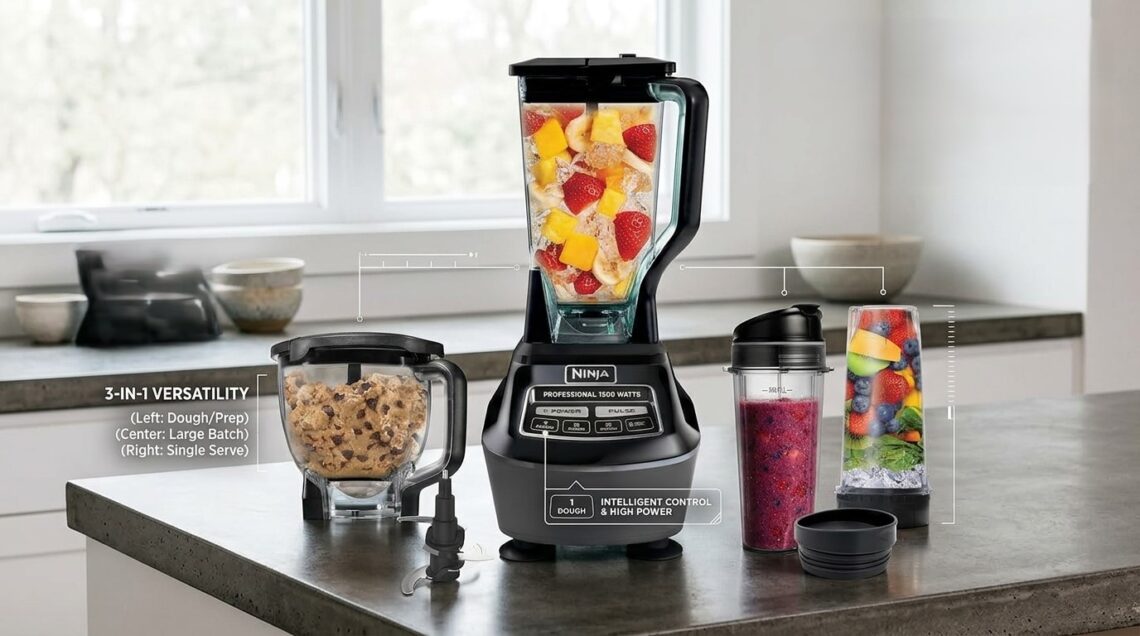
The Ninja Kitchen System exemplifies this approach with its three-piece accessory bundle that includes a pitcher for blended beverages, two 16-ounce portable cups, and an 8-cup processing bowl. Each attachment serves different culinary purposes, which we’ll explore in detail throughout this article.
Key Features of All-in-One Kitchen Systems
Motor Power and Performance
The motor is the heart of any multi-function kitchen system. A robust motor determines how efficiently the appliance can handle various tasks, from liquefying frozen fruits to pulverizing whole grains or kneading bread dough.
Ninja systems are known for incorporating powerful motors that operate at multiple speed settings. This variable control matters significantly. When you’re making a delicate vinaigrette or crushing ice for cocktails, you don’t necessarily need maximum power. Conversely, processing dense ingredients like nut butter or thick dough requires sustained, consistent force. Having multiple speed options allows you to match the power output to the specific task at hand.
The ability to switch between speeds also extends motor longevity. Running at full power continuously creates heat buildup and unnecessary wear. When a machine allows you to use the appropriate speed for each task, the motor experiences less stress and maintains performance over many years of use.
Multiple Attachment Configurations
The three-piece setup that accompanies many of these systems serves distinct purposes. The pitcher is typically designed for blending liquids and soft ingredients—think smoothies, protein shakes, soups, and sauces. Its shape and blade orientation optimize the circulation of ingredients with the motor’s base, creating an efficient vortex that combines ingredients thoroughly.
The individual 16-ounce cups represent a shift toward personal-sized servings and portability. These smaller containers allow you to prepare a single smoothie or protein shake without filling a large pitcher with leftovers. Many users appreciate these cups for meal prep, as they can prepare several drinks in advance and store them in the refrigerator.
The 8-cup processing bowl takes on tasks that differ fundamentally from blending. When you’re chopping vegetables, grating cheese, making salsa, or mixing pizza dough, you’re not creating a homogeneous liquid. Instead, you’re using the processing bowl and its specialized blades to cut, shred, or knead ingredients while maintaining some textural distinction between components.
Blade and Attachment Variety
Different culinary tasks require different blade geometries. Standard blending blades have a particular angle and configuration that creates directional flow patterns. Processing blades work differently, using cutting and shearing motions rather than the circular vortex pattern of blending.
Some systems include specialized attachments for different purposes—a dough hook for bread making, specialized cutters for different textures, or variable blade sets optimized for different food types. Understanding which attachments come with your system and what each one does helps you get maximum utility from your investment.
Container Materials and Safety
The pitchers and bowls accompanying these systems are constructed from durable materials designed to withstand regular use and the heat generated during processing. Most feature measurement markings on the sides, which proves helpful when following recipes or portioning ingredients.
Safety features are increasingly standard on modern appliances. Many systems include a safety interlock that prevents the motor from running unless the container is properly seated and locked into place. Cord storage solutions keep your counter organized and the appliance more compact when not in use.
Practical Applications and Everyday Uses
Understanding how a multi-function system fits into real cooking scenarios helps you determine whether it’s the right choice for your kitchen.
Breakfast and Beverage Preparation
Smoothies and blended beverages represent perhaps the most obvious application. Whether you’re making a tropical fruit smoothie with yogurt and coconut milk, a protein-packed breakfast shake with oats and nuts, or a green smoothie with leafy greens and fruit, the blending pitcher handles these tasks efficiently.
Beyond smoothies, the system can create freshly blended soups. You can sauté vegetables in a separate pot, then transfer them to the pitcher with broth and blend to your desired consistency. This allows you to make creamy vegetable soups—butternut squash, broccoli cheddar, tomato bisque—without using heavy cream or butter. The blending process incorporates air, creating a naturally thick, satisfying texture.
The portable cups work well for meal prep. Making five smoothies on Sunday for the week ahead means you have grab-and-go breakfasts ready whenever you need them. Store them in the refrigerator, and you have a ready-made breakfast that requires no morning preparation.
Sauce and Condiment Creation
Making salsa represents an ideal middle ground between blending and food processing. You want the ingredients sufficiently combined, but you typically prefer some chunky texture rather than a completely smooth result. The processing bowl, with its shorter processing times and specific blade configuration, handles this task well.
The same applies to pesto, hummus, guacamole, and similar condiments. You can combine nuts, herbs, oils, and other ingredients to create flavorful condiments that taste noticeably fresher than store-bought alternatives.
Nut butters represent another compelling application. Whole nuts are fed into the processor, and the rapid blade motion generates friction heat while grinding the nuts down to a spreadable consistency. Making almond butter, peanut butter, cashew butter, or mixed-nut butter at home allows you to control ingredients—no added sugars or oils unless you choose to add them.
Dough and Baked Goods
The processing bowl serves admirably for mixing pizza dough, bread dough, and pie crust. Rather than spending time kneading by hand or investing in a stand mixer, the food processor handles initial mixing and initial kneading in a matter of seconds. This speeds up the bread-making process while reducing the physical effort required.
Cookie doughs, muffin batters, and other baked good preparations also benefit from the food processor. The speed and consistency it brings to mixing means more even incorporation of ingredients, which often results in better textural outcomes.
Vegetable and Ingredient Preparation
Regular food processors excel at vegetable chopping and slicing, and multi-function systems maintain this capability. Chopping onions, bell peppers, garlic, carrots, or celery for soups, stews, or stir-fries is faster and more consistent with a food processor than knife work, especially when handling large quantities.
Grating cheese, shredding vegetables like carrots or zucchini, and slicing items uniformly are all within the processor’s wheelhouse. For someone making multiple meals or preparing ingredients for a week of cooking, the time savings add up considerably.
Purees and Baby Food
Parents often appreciate multi-function systems for preparing homemade baby food. Steaming vegetables or fruits, then processing them to an appropriate consistency, allows you to create simple, ingredient-controlled foods for developing palates.
Grain and Nut Grinding
Some systems handle grinding grains into flour, processing nuts for coating or mixing into dishes, or even making coffee if you use whole beans. While perhaps not the most common application, the ability to process whole grains into flour opens possibilities for fresh-ground whole grain baking.
Who Might Benefit Most From a Multi-Function System
Limited Kitchen Space
Apartment dwellers, small house owners, or anyone with modest counter and storage space benefits significantly from consolidating multiple appliances into one. If you’ve been choosing between different appliances due to space constraints, a multi-function system solves that dilemma.
Health-Conscious Home Cooks
People focused on whole food nutrition appreciate being able to quickly prepare smoothies, fresh sauces, homemade nut butters, and vegetable-based dishes. The minimal processing time and control over ingredients appeals to those monitoring their diet carefully.
Busy Individuals and Families
Parents, professionals, and anyone with limited time finds value in meal prep efficiency. Preparing multiple smoothies, batches of soup, or pre-cut vegetables for the week ahead takes significantly less time with a multi-function system than alternative methods.
Culinary Enthusiasts
Home cooks who enjoy experimenting with recipes appreciate the versatility and reliability that a quality multi-function system offers. The ability to quickly execute various culinary techniques without hunting down different equipment encourages more ambitious cooking.
People Reevaluating Kitchen Equipment
Anyone currently storing multiple single-purpose appliances might discover that a multi-function system meets their actual needs more efficiently. Sometimes what we think we need differs from what we actually use regularly.
Important Considerations Before Purchasing
Understanding Actual Versus Theoretical Capacity
The 8-cup bowl size indicates the maximum volume it can hold, not the ideal working capacity. Most recipes call for filling the bowl only partway—perhaps to the 5-cup mark—to allow proper mixing and blade clearance. Understanding this distinction helps prevent overfilling and ineffective processing.
Noise Level
All food processors and high-powered blenders generate significant noise. If you live in an apartment with close neighbors or have a preference for a quieter kitchen environment, it’s worth knowing that these appliances operate louder than smaller, less powerful equipment. Preparing smoothies at 6 AM might raise concerns among household members.
Space Requirements
While a multi-function system requires less total storage space than multiple separate appliances, it still needs adequate counter space during use. Consider where you’ll keep it when in use and ensure your kitchen layout accommodates an appliance with reasonable footprint.
Learning the System
Different attachments require different assembly and operation procedures. While manufacturers provide instruction manuals and online resources, there’s a slight learning curve. Understanding which attachment suits different tasks, how to properly assemble each configuration, and how to clean and maintain the system takes time initially.
Cleaning and Maintenance
Unlike simple blenders, multi-function systems have more components—various bowls, pitchers, lids, and attachments. Cleaning time increases accordingly, though most modern systems feature dishwasher-safe components that simplify the process. The base unit itself requires occasional cleaning with a damp cloth.
Motor Longevity
Quality construction and appropriate usage patterns determine how long a motor functions effectively. Running the system continuously at maximum speed without breaks, processing ingredients that exceed capability (like whole ice cubes repeatedly), or using incorrect attachments for specific tasks shortens the motor’s lifespan.
How Multi-Function Systems Compare to Single-Purpose Alternatives
Blender Compared to Multi-Function Systems
Dedicated blenders often excel at purely liquid-based tasks. A high-end blender focused specifically on blending may have blade designs optimized solely for that purpose, potentially offering smoother results for beverages. However, a multi-function system’s blending capabilities prove more than adequate for most household needs. The trade-off is gaining additional functionality at the potential cost of specialized optimization for any single task.
Food Processor Compared to Multi-Function Systems
The same logic applies to food processors. A dedicated food processor might offer larger bowl capacities, more specialized attachment options, or blades engineered specifically for processing tasks. For serious food preparation enthusiasts or commercial applications, dedicated equipment might outperform a multi-function system. For household use, however, the integrated system handles typical food processing needs effectively.
Stand Mixer Compared to Multi-Function Systems
Stand mixers excel at sustained mixing and kneading operations, particularly for dough work where consistent motion over extended periods matters. A multi-function system’s processor attachment handles initial mixing but might not replicate the precision and duration capability of a dedicated stand mixer for serious bread baking. For casual home baking and dough preparation, however, the processor performs admirably.
Overall Value Proposition
For most households, the convenience of having blending, food processing, and mixing capabilities in one unit outweighs any slight performance differences compared to specialized equipment. The space savings, reduced financial investment, and streamlined kitchen workflow appeal to the average home cook more than specialized single-purpose appliances.
Practical Tips for Effective Usage
Ingredient Preparation
Softer ingredients typically process faster than harder ones. When combining varied ingredients in the food processor, starting with harder items and adding softer ones partway through often produces more consistent results. This prevents overprocessing soft ingredients while waiting for harder components to break down.
Blending Order
When preparing blended drinks, the order in which you add ingredients affects the outcome. Adding liquids first, then solids, then soft ingredients typically produces smoother, more thoroughly combined results. This approach also minimizes the chance of ingredients getting stuck under the blades.
Temperature Considerations
Hot ingredients and cold ingredients behave differently in blenders and processors. Hot liquids generate steam, which can affect the blending process and potentially create safety concerns. Most manufacturers recommend allowing hot ingredients to cool before blending. Conversely, some applications benefit from partially frozen or very cold ingredients.
Texture Control
Processing time directly influences final texture. For chunky salsa, brief pulses preserve distinct pieces. For smooth sauce, longer processing times create homogeneity. Understanding your desired end result and adjusting processing time accordingly takes some trial and error but becomes intuitive with experience.
Cleaning Immediately After Use
Most users find that cleaning the bowl and attachments immediately after use prevents ingredient residue from hardening and becoming difficult to remove. While many components are dishwasher safe, hand washing with warm soapy water and a brush remains quick and effective.
Frequently Asked Questions
Can a multi-function system handle hot liquids?
Most manufacturers recommend allowing soups and other hot ingredients to cool before blending. The heated liquid generates steam, which can create pressure and potentially cause the lid to pop off. If you must blend hot ingredients, allow the liquid to cool to warm temperature and fill the pitcher only partway to leave headspace.
How long do these systems typically last?
With proper care and appropriate usage, a quality multi-function kitchen system can function effectively for five to ten years or longer. Lifespan depends on frequency of use, whether usage matches the appliance’s intended purpose, and whether you perform basic maintenance like regular cleaning.
Can you process frozen fruit directly, or does it need to thaw first?
Most multi-function systems with adequate motor power handle frozen fruit directly. However, starting with thawed fruit or partially thawed fruit often produces smoother blending results and is gentler on the motor. When processing frozen ingredients, you might need to use the highest speed setting and allow slightly longer processing time.
Is the 8-cup bowl size adequate for family cooking?
This depends on your household size and typical meal prep volume. For a family of four preparing one batch of sauce or processing vegetables for a single meal, an 8-cup bowl often suffices. For larger-scale meal prep or cooking for bigger groups, the capacity might feel limiting, requiring multiple batches.
What’s the difference between pulsing and continuous blending?
Pulsing involves short bursts of the motor at full power with pauses between. This approach gives you more control over texture and prevents overprocessing. Continuous blending runs the motor steadily, ideal for creating smooth, homogeneous results. Learning when each approach suits your needs improves your results.
Can these systems grind whole grains into flour?
Many multi-function systems with adequate motor power can grind grains into flour, though this represents a more demanding task than typical processing. The heat generated can potentially affect flour qualities. For regular grain grinding and flour production, a dedicated grain mill might prove more practical.
Are replacement parts readily available?
Quality brands like Ninja typically make replacement parts available through their website or authorized retailers. Whether you need a replacement pitcher, bowl, blade set, or other components, availability is usually straightforward, though part costs vary. This availability supports long-term ownership.
Conclusion
Multi-function kitchen systems represent a pragmatic solution for modern home cooking. By consolidating blending, food processing, and mixing capabilities into a single powerful unit, these systems address real kitchen constraints—limited space, competing appliance desires, and the desire for efficient meal preparation. The Ninja Kitchen System, with its powerful motor and versatile attachment bundle including a pitcher, two 16-ounce portable cups, and an 8-cup processing bowl, exemplifies how a well-designed multi-function system can handle diverse culinary tasks.
Whether you’re preparing quick weekday smoothies, creating fresh sauces and condiments, making pizza dough for dinner, or tackling vegetable prep for meal planning, a multi-function system streamlines your process. The learning curve is minimal, and most users find that their frequency of cooking and food preparation increases when they have convenient, efficient equipment accessible on the counter.
As with any kitchen appliance, the right choice depends on your specific cooking habits, available space, and culinary interests. If you frequently find yourself wishing for easier meal prep, faster beverage blending, or more efficient ingredient processing, a multi-function system merits consideration. The consolidation of capabilities delivers genuine practical value for most home cooks who prioritize efficiency and kitchen functionality.